Posts

Showing posts with the label stars

Aldebaran

Image
  “The Follower.” Significance in Human Observation Historical Observation: Aldebaran has been observed by humans for thousands of years. Ancient civilizations, such as the Mesopotamians and Egyptians, recognized it and incorporated it into their myths and calendars. Modern Astronomy: In modern times, Aldebaran has been extensively studied. Its position and brightness make it important for celestial navigation, and it remains a subject of interest in astrophysical research. This timeline captures the major phases in the life of Aldebaran, from its formation billions of years ago to its current state as a red giant and its eventual fate as a white dwarf and beyond. Aldebaran is easily visible to the naked eye. Main Sequence Phase: Aldebaran spent most of its life as a main sequence star, similar to the Sun. Aldebaran formed from a cloud of gas and dust in the Milky Way galaxy. This process, known as stellar formation, occurred within a nebula, where gravity caused material to collap...

Discovery Altair

Image
  A team of astronomers in Japan who are currently attempting to listen for a potential alien response to a message that was sent into space forty years ago. The message was originally transmitted in 1983 to the star Altair, located light years away from Earth. The effort to receive an alien response is now being led by astronomer of the University of Hyogo. The team is using a telescope belonging to the Japanese space agency, JAXA, for this purpose. The message consisted of drawings and intended to convey information about human civilization and our species. So also NASA have try to Discovery Altair for long time, specially given the discoveries of numerous exoplanets since the 1990. He suggests to international space agency that Altair might have a planet with conditions suitable for sustaining life. Underscores the vast distances and timeframes involved in interstellar communication and the challenges faced in detecting potential extraterrestrial responses.

DISCOVERY OF DUST BELTS AROUND PROXIMA CENTAURI

Image
DISCOVERY OF DUST BELTS AROUND PROXIMA CENTAURI astronomer at the Institute of Astrophysics of Andalusia in Spain, said in a press release https://www.eso.org/public/news/eso1735/?lang Proxima Centauri, the star closest to our Sun, is known to host at least one terrestrial planet candidate in a temperate orbit. Here we report the ALMA detection of the star at 1.3 mm wavelength and the discovery of a belt of dust orbiting around it at distances ranging between 1 and 4 au, approximately. Given the low luminosity of the Proxima Centauri star Proxima Centauri is already known to have one Earth-sized world around it, and now astronomers have detected dust belts that could be an indication of more. “The dust around Proxima is important because, following the discovery of the terrestrial planet Proxima b, it’s the first indication of the presence of an elaborate planetary system, and not just a single planet, around the star closest to our sun https://www.eso.org/public/archive...

Stars

Image
For thousands of years, people have wondered about the stars. Even today, when we’re distracted by indoor living and artificial lights, most of us find the stars beautiful and fascinating Information s about the most interesting stars in our galaxy and beyond, about our solar system and other galaxies,Astronomy like night-sky events  visual and numerical form like laser technology,explain basics of Astronomy stars, and other astronomical objects, astronomy probably began as a natural curiosity. Eventually, over a scale to define the brightness's of stars.

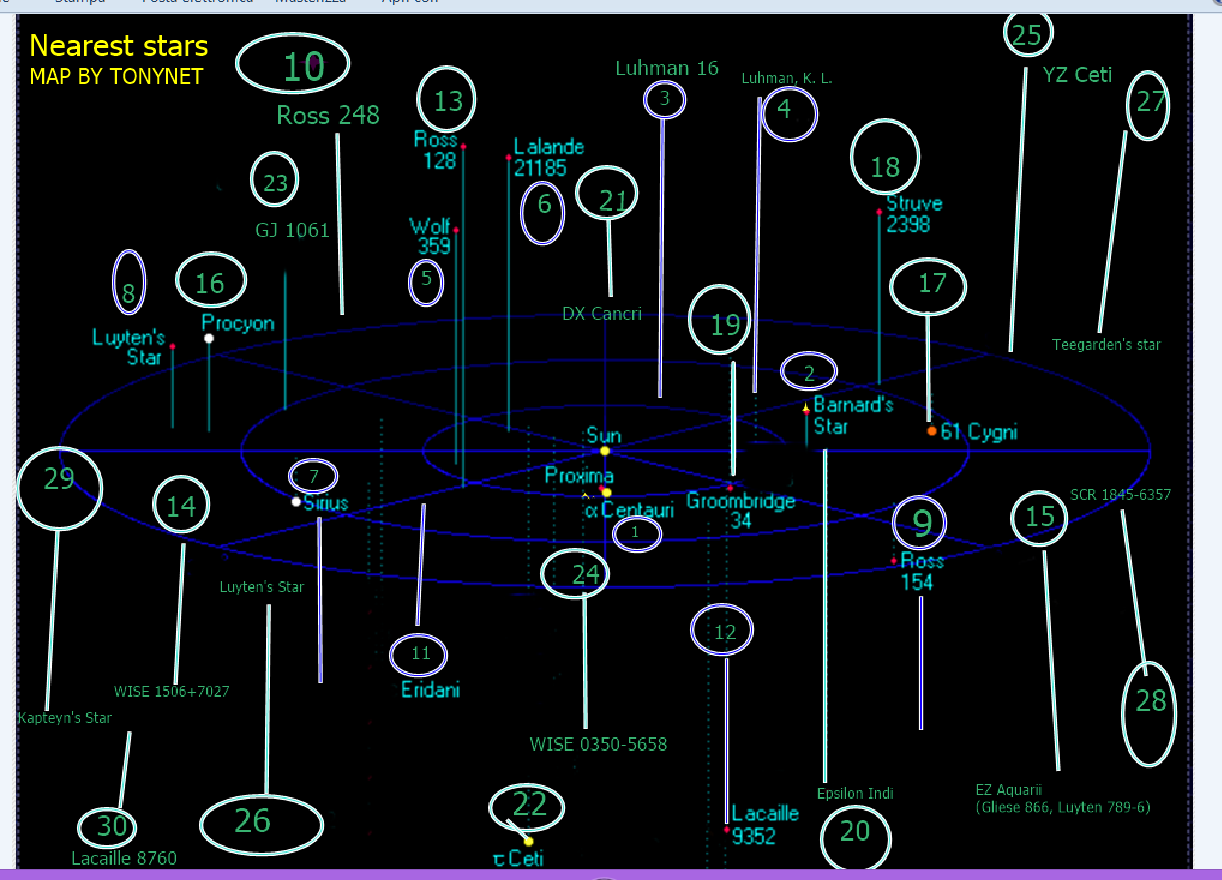
Nearest stars

Image
Solar System Sun Proxima Centauri Centauri A Centauri B Barnard's Star Luhman 16 WISE 0855−0714 Wolf 359 Lalande 21185 Sirius Luyten 726-8 Ross 154 Ross 248 Epsilon Eridani Lacaille 9352 Ross 128 WISE 1506+7027 EZ Aquarii(Gliese 866, Luyten 789-6) Procyon 61 Cygni Struve 2398 (Gliese 725, BD+59°1915) Groombridge 34 (Gliese 15) Epsilon Indi DX Cancri Tau Ceti GJ 1061 WISE 0350−5658 YZ Ceti (LHS 138) Luyten's Star Teegarden's star SCR 1845-6357 Kapteyn's Star Lacaille 8760